

Cardamom is one of the most valuable spices traded in India, and its price can change significantly based on auction arrivals, quality, demand, supply conditions, seasonal patterns, and market movements. For cardamom farmers, traders, buyers, and spice businesses, knowing the current price is important — but understanding where prices may move next can be even more valuable.
This is where AI Cardamom Price Prediction can help.
SpiceValue uses historical auction data, statistical analysis, machine learning, and market indicators to provide an AI-powered outlook for cardamom prices on the Predictions page. The objective is to help users understand market trends and make better-informed decisions based on data. This guide explains what goes into the model, shows a real prediction against the auction that followed, and reports how accurate the method has been over the last 500 auction days.
What is AI cardamom price prediction?
AI Cardamom Price Prediction is the use of artificial intelligence and historical market data to estimate the possible future movement of cardamom prices.
Instead of looking only at the latest cardamom auction price, an AI-based system can analyze historical patterns and identify relationships between different market variables.
The prediction process can consider factors such as:
- Historical cardamom auction prices
- Auction arrivals
- Seasonal price patterns
- Recent price movements
- Supply and demand indicators
- Price volatility
- Historical market trends
- Changes in auction performance
By processing this information, an AI model can generate an indicative outlook for future cardamom prices.
It is important to understand that an AI prediction is not a guaranteed future price. Commodity markets can change because of unexpected agricultural, weather, supply, demand, and market conditions.
Why farmers ask "sell now, or wait?"
Cardamom farmers regularly face an important question:
"Should I sell my cardamom now, or could the price improve?"
There is no simple answer to this question because the market can change quickly.
Today's cardamom price may be different from tomorrow's auction price. Similarly, a short-term increase does not necessarily mean that prices will continue rising.
This is why historical data and market trends can be useful.
An AI-powered outlook can provide an additional perspective by analyzing large amounts of historical information and identifying patterns that may not be easy to detect manually.
The prediction should be used alongside the farmer's own experience, current market information, crop conditions, and other relevant factors.
How the SpiceValue model works
SpiceValue's prediction system is designed to analyze historical cardamom auction information and generate an indicative market outlook.
The system combines statistical analysis with machine-learning techniques to identify patterns in historical data. Every figure is computed from the Spices Board e-auction record for Puttady and Bodinayakanur, and the method is described in full at the bottom of the Predictions page.
1. Historical auction data
Historical cardamom auction data provides the foundation for understanding how prices have behaved over time.
By studying previous auction prices and market movements, an AI model can identify recurring patterns and trends. The same archive is searchable on the Auctions page.
2. Seasonal patterns
Agricultural commodity prices can show seasonal behavior.
Cardamom production, harvesting cycles, auction arrivals, and market demand can change throughout the year.
The model builds a seasonal index for each month from the archive: the month's average price divided by that year's average, averaged across years. In the current archive, September sits at 108 and May at 89, meaning September has historically been about 8% dearer than the year's average and May about 11% cheaper. The 30-day and 90-day outlooks apply that ratio to the recent 10-auction average.
3. Auction arrivals
Auction arrivals can have an important relationship with market prices.
Changes in the quantity of cardamom arriving at auctions can influence supply conditions. The Predictions page shows the historical relationship between arrivals and prices so you can see the current supply signal against it.
4. Price trends
The model can analyze recent price movements and compare them with historical market behavior.
This can help identify whether the market is showing signs of an upward trend, downward trend, or relatively stable movement.
5. Machine learning
The next-auction estimate is an ensemble of two parts. A statistical anchor blends the latest weighted average with the 5-auction average. A ridge-regression model, trained on the full archive with the last five prices, two moving averages and the month of the year as inputs, adds longer-lag structure and seasonality. The two are combined 70/30, and the likely band around the estimate is one standard deviation of the last 30 day-to-day moves.
As new auction rows arrive, the model is retrained and the estimate is checked against what the auction actually printed.
What a real prediction looked like
This is the outlook panel as it stood on 12 September 2026, after the Puttady auction that day.
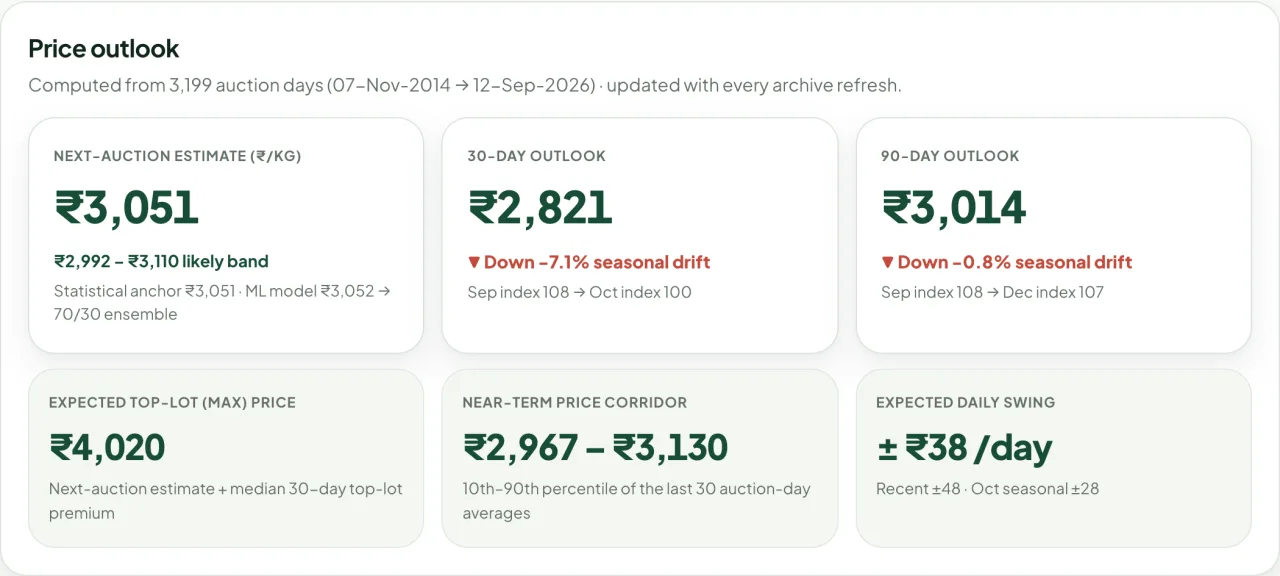
Here is how the same method performed on the auctions leading up to it. Each row shows the estimate the model would have produced from the previous auction, the band, and the weighted average that was then printed.
| Auction date | Estimate (₹/kg) | Likely band | Actual (₹/kg) | Miss |
|---|---|---|---|---|
| 4 Sep 2026 | 3,017 | ± 61 | 3,079 | 62, just outside the band |
| 7 Sep 2026 | 3,074 | ± 62 | 2,950 | 124, outside the band |
| 8 Sep 2026 | 2,956 | ± 63 | 3,019 | 63, at the edge |
| 9 Sep 2026 | 3,012 | ± 65 | 3,078 | 66, at the edge |
| 10 Sep 2026 | 3,081 | ± 65 | 3,068 | 13 |
| 11 Sep 2026 | 3,063 | ± 64 | 3,050 | 13 |
| 12 Sep 2026 | 3,047 | ± 63 | 3,051 | 4 |
Two things stand out. Quiet days land inside the band. The drop on 7 September, a fall of ₹129 from one auction to the next, was not called by the model, and no method built on the price series alone would have called it. That is the honest shape of this market.
The 30-day seasonal outlook made on 13 August 2026 put the level for 12 September at ₹3,095, from a 10-auction average of ₹3,062 and an August-to-September seasonal drift of 107 to 108. The auction on 12 September printed ₹3,051, a difference of about 1.4%.
How accurate is it? Backtest results
Accuracy claims should come from a test the model could not have seen. SpiceValue runs a walk-forward backtest: for each of the last 500 auction days, the model is trained only on the auctions before that day, makes its estimate, and is then scored against the price that was actually printed. The window covers 6 January 2025 to 12 September 2026, with an average price of about ₹2,600 per kg.
| Measure, next-auction estimate | Result |
|---|---|
| Mean absolute error | ₹41 per kg, about 1.6% of price |
| Median absolute error | ₹33 per kg |
| Actual price inside the likely band | 65% of auctions |
| Actual price inside twice the band | 93% of auctions |
| Direction of the next move called correctly | 52% |
The last line matters. Day-to-day, small cardamom behaves close to a random walk: assuming the next auction prints the same as the last one gives almost the same error as the model. The value of the next-auction estimate is the level and the band, not the arrow. It tells you what a normal print looks like tomorrow and how far a surprise would have to go.
The seasonal outlook is where the archive adds something. Over the same window, the 30-day outlook missed the level 30 days later by ₹140 on average, against ₹171 for assuming no change. When it called a move of more than half a percent, the direction was right 69.5% of the time, on 452 calls.
These figures are recomputed as the archive grows and will drift. Treat them as the current state of the method, not a promise.
Reading the outlook: up, stable, or down
An AI prediction should not be interpreted as an exact promise of tomorrow's cardamom price.
Instead, it can provide an indicative price outlook.
For example, a prediction may suggest that the market currently has:
- 📈 Potential upward momentum
- ➡️ A relatively stable trend
- 📉 Potential downward pressure
The actual market can still move differently.
The value of AI is in helping users analyze available data systematically rather than relying entirely on guesswork.
Prediction vs. cardamom price today
There is an important difference between knowing the cardamom price today and understanding a possible future price trend.
Cardamom price today
The current price tells you what the market is doing now.
It is useful for:
- Checking the latest market price
- Comparing auction prices
- Understanding current market conditions
- Monitoring daily changes
The AI outlook
An AI prediction attempts to provide an indication of what could happen next based on historical patterns and available market data.
It can help users consider:
- Recent price momentum
- Historical trends
- Seasonal patterns
- Auction arrivals
- Potential future price direction
Using both current prices and predictive insights gives users a broader view of the cardamom market.
Why ten years of auction history matters
Historical data is one of the most important components of any data-driven prediction system.
Cardamom markets have experienced different price cycles over the years. By studying historical auction prices, an AI system can learn how prices behaved during different market conditions.
SpiceValue's model uses more than 10 years of Spices Board auction history, 3,199 auction days from November 2014 to the latest session, as part of its analysis.
This historical perspective can help identify long-term patterns while the latest market information helps provide a more current outlook.
Can AI predict the exact cardamom price?
No.
Even sophisticated artificial intelligence models cannot guarantee an exact future cardamom price.
There are many factors that can affect cardamom prices, including:
- Weather conditions
- Production levels
- Crop diseases and pest pressure
- Auction arrivals
- Cardamom quality
- Domestic demand
- Export demand
- Supply conditions
- Market sentiment
- Unexpected changes in the market
Because these factors can change unexpectedly, an AI forecast should be treated as market intelligence, not a guaranteed price.
Who the outlook helps
Cardamom farmers
Farmers can use AI-based market insights as one additional source of information when monitoring price trends and planning sales.
Cardamom traders
Traders can compare current auction prices with historical trends and AI-generated market outlooks.
Spice buyers
Buyers can use market intelligence to monitor potential changes in cardamom prices.
Spice businesses
Businesses involved in sourcing, processing, trading, or selling cardamom can use price trends to support purchasing and market planning.
Using the outlook with live prices and charts
AI prediction becomes more useful when it is combined with current market information.
A practical approach is to monitor:
Current cardamom price + auction arrivals + historical trends + seasonal patterns + AI outlook
Instead of relying on a single number, users can look at the overall market picture.
For example, if the current price is increasing but auction arrivals are also rising significantly, the market may behave differently than a situation where prices are increasing while arrivals remain limited.
This type of combined analysis can provide better context. Live prices give the current print, Charts give the trend, and Predictions give the outlook. Cardamom price trends explains how to read the chart before you look at the band.
Where to find it
SpiceValue is building a data-driven platform focused on helping people understand the spice market.
The Predictions page brings together historical market data and machine learning to provide insights into potential future price movements: a next-auction estimate with its band, 30-day and 90-day outlooks, a seasonal calendar, an arrival outlook, and supply and demand signals. The model runs in your browser on the full archive each time the page loads.
The goal is simple:
Make spice market information easier to understand through data and technology.
What comes next for AI in the cardamom market
Artificial intelligence has significant potential in agricultural commodity markets.
As more reliable market data becomes available, AI systems can become increasingly useful for analyzing complex market patterns.
Future developments could include:
- Short-term cardamom price forecasts
- Weekly cardamom price outlooks
- Auction trend analysis
- Price movement alerts
- Historical price comparisons
- Market volatility indicators
- Supply and demand analysis
- Personalized market notifications
- AI predictions for other major spices
AI will not replace the experience of farmers and traders. Instead, it can complement their knowledge by providing another data-driven perspective.
Frequently asked questions about AI cardamom price prediction
What is AI cardamom price prediction?
AI Cardamom Price Prediction uses artificial intelligence, historical auction data, statistical analysis, and machine-learning techniques to estimate potential future cardamom price movements.
Is AI cardamom price prediction accurate?
In a walk-forward backtest over the last 500 auction days, SpiceValue's next-auction estimate missed the printed weighted average by ₹41 per kg on average, about 1.6% of price, and the actual price landed inside the likely band 65% of the time. The 30-day seasonal outlook called the direction of the move correctly about 70% of the time. It cannot guarantee future prices, and sudden moves caused by weather, arrivals, quality or demand are not predictable from the price series.
Can AI predict tomorrow's cardamom price?
AI can generate an indicative short-term estimate with a band based on available historical and current data. However, the actual price can be different from the prediction.
Where can I check AI cardamom price prediction?
You can explore the latest AI Cardamom Price Prediction and related market insights on SpiceValue's Predictions page.
What factors affect cardamom prices?
Cardamom prices can be influenced by auction arrivals, quality, production, supply, demand, weather, seasonal conditions, domestic consumption, exports, and overall market conditions.
Is cardamom price prediction useful for farmers?
It can be useful as an additional source of market information. Farmers should consider AI predictions together with current auction prices, crop conditions, market demand, and their own experience.
Conclusion
The cardamom market can be difficult to predict because prices are influenced by many changing factors. However, historical data and artificial intelligence can provide useful insights into market patterns and potential future price movements.
AI Cardamom Price Prediction is not about guaranteeing tomorrow's exact price. It is about using data, statistical analysis, and machine learning to understand the market better, and about being honest when the market moves outside the band.
For farmers, traders, buyers, and spice businesses, combining cardamom price today with historical trends, auction information, and AI-powered predictions can provide a more complete picture of the market.
SpiceValue is working toward making this information simpler, smarter, and more accessible to everyone interested in the spice market.
SpiceValue — Smarter Insights for the Spice Market.
Disclaimer
AI-generated cardamom price predictions are estimates based on available historical and market data. They are provided for informational and educational purposes only and should not be considered guaranteed future prices, financial advice, or a recommendation to buy or sell cardamom. Actual prices may vary due to market, agricultural, weather, supply, demand, auction, quality, and other factors. Backtest figures quoted in this article were computed on 12 September 2026 and change as the archive grows.
